
If you’re considering custom metal countertops, the first question is usually pretty simple:
What’s the best metal to use?
The answer isn’t quite as simple.
It depends on what you’re trying to accomplish.
Is the countertop primarily decorative? Does it need to stand up to water, heat, food preparation, and daily use? Are you trying to create a particular look? Or does it need to do all of those things at once?
At Beacon Metal Fabricators, that’s where we like to start.
We’ve built metal countertops and other custom kitchen pieces for homeowners, interior designers, restaurants, bars, and commercial spaces. We’ve worked with stainless steel, zinc, copper, brass, galvanized steel, and combinations of different materials.
Each one behaves differently.
The trick isn’t finding the “best” metal.
It’s finding the right metal for what you’re trying to build.
Start with What the Countertop Needs to Do
A countertop can look great and still be wrong for the application.
That’s especially important with metal.
Some metals excel in wet, high-use areas. Others are chosen because of the way they look or change with age. Some can be difficult to fabricate but create a finished piece you simply can’t get with a conventional countertop material.
So before we start talking about stainless versus zinc or copper, we want to understand how the space will actually be used.
A working kitchen and a decorative bar don’t necessarily need the same material.
Neither do an indoor kitchen and an outdoor cooking area.
And sometimes the best answer isn’t one material at all.
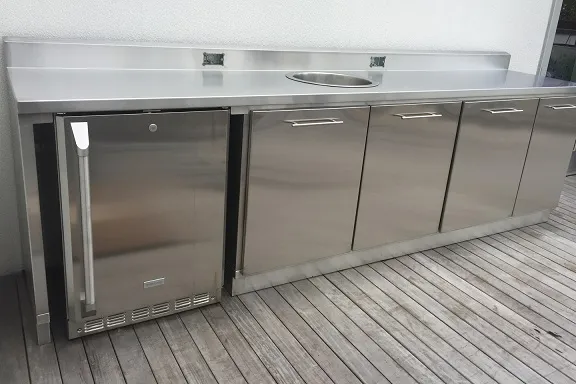
There's a Reason Kitchens Rely on Stainless Steel Countertops
Stainless steel countertops aren’t common in professional kitchens by accident.
They’re durable. They’re easy to clean. And they work especially well around water and in areas that see constant use.
For a residential kitchen, though, you don’t necessarily need stainless everywhere.
One of our favorite approaches to stainless steel kitchen countertops is using the material where its strengths matter most, particularly around the sink.
Instead of having seams or countertop materials that can absorb moisture around one of the wettest areas in the kitchen, a custom stainless steel countertop can create a durable work surface designed specifically for that space.
We’ve also worked on residential kitchens where professional-grade performance was part of the goal. In those applications, stainless isn’t being chosen just because somebody likes the industrial look.
It’s there because it works.
What Makes Zinc Countertops Different?
If stainless is the practical workhorse, zinc is a very different animal.
Zinc countertops have a distinctive appearance, and the material develops more character as it’s used. That’s one reason we’re seeing renewed interest in zinc from interior designers looking for something different from the materials found in most kitchens.
But there’s something you don’t necessarily see in the finished photos.
Zinc is extremely soft.
That makes a zinc countertop much more challenging to fabricate well than someone unfamiliar with the material might expect.
The bends, seams, edges, and other details all have to be handled with an understanding of how the material behaves.
We’ve fabricated zinc pantry countertops as well as zinc countertops incorporating copper accents. Projects like these are a good example of why custom metalwork isn’t just about choosing a material you like.
You also need someone who knows what to do with it.
A Little Copper or Brass Goes a Long Way
Copper countertops can create a striking look, but an entire countertop doesn’t have to be copper for the material to make an impact.
Sometimes the right accent makes the whole piece.
We’ve incorporated copper into zinc countertops and brass inlays into stainless steel, using contrasting metals to add detail and character without making the entire countertop from the same material.
It’s another advantage of going custom: you’re not limited to one metal, one finish, or one way of putting them together.
You’re not limited to choosing Option A, B, or C from a catalog.
Different metals can work together.
Does Every Countertop Have to Match?
Not at all.
In fact, we think some of the most functional kitchens use different materials for different jobs.
You might use stainless around a sink because it handles water exceptionally well.
A butcher block may make sense somewhere else.
Granite or another traditional countertop material might be exactly what you want for another part of the room.
There’s no rule saying every square foot has to be made from the same thing.
When you’re investing in a custom kitchen, it makes more sense to ask what works best in each area than to force one material to do everything.
That’s where working with an interior designer and an experienced fabricator can open up possibilities you may not get from a standard countertop supplier.
Metal Countertops Can Go Outside, Too
The same approach applies to outdoor kitchen countertops and other exterior work surfaces.
Now the environment becomes part of the equation.
Weather exposure, moisture, durability, appearance, and intended use can all influence the material and construction.
And sometimes the project isn’t technically a kitchen at all.
We’ve fabricated a galvanized steel corner worktable with an integrated welded sink for a homeowner’s garden potting area. It had to fit a particular space and serve a particular purpose, so it was built around both.
That’s custom fabrication in a nutshell.
You start with what the customer needs, then figure out the best way to build it.
Restaurants and Bars Have Their Own Challenges
Commercial spaces introduce another set of problems.
If a restaurant needs a standard stainless worktable in a standard size, there are manufacturers that produce them every day. That’s usually going to be the quickest and most economical way to buy one.
That’s not where Beacon provides the most value.
We tend to get involved when the standard solution doesn’t work.
Maybe a restaurant has a tight space that requires a counter built to an unusual dimension.
Maybe the original supplier can’t provide what’s needed.
Maybe the project has a lead-time problem.
Bars are an especially good example.
Every bar can be different. Some are rectangular. Others curve, form a horseshoe, or follow the architecture of the room. Features like a metal bar top, drink rail, or drain trough may have to follow those exact dimensions.
That’s when custom fabrication stops being a luxury and starts becoming the practical solution.
Your Kitchen Doesn't Have to Come Out of a Catalog
One of the things we enjoy most about this work is that every project can be different.
A designer may come to us with a detailed vision.
A homeowner may know what they want the finished kitchen to feel like but not know which metal will get them there.
A restaurant owner may simply have a space where nothing standard fits.
That’s fine.
You don’t need to know how to fabricate it before you call us. That’s our part of the job.
Bring us the drawings. Bring us the dimensions. Bring us the idea you’re trying to work through.
We’ll help determine what material makes sense, how it can be fabricated, and what it will take to turn that idea into something you can actually use.
Because when it comes to custom metal countertops, the best material isn’t the one that’s most popular.
It’s the one that’s right for your kitchen.
At Beacon, we like projects that make us think a little. If you have an idea for a countertop, kitchen feature, or piece of custom metalwork that doesn’t come with an obvious off-the-shelf answer, we’d like to hear about it.